
-0.6.0.dev1062-gold?style=flat)
注釈
サンプルコードを全てダウンロードするには 末尾に移動 。
ICON Mesh (Projected)#
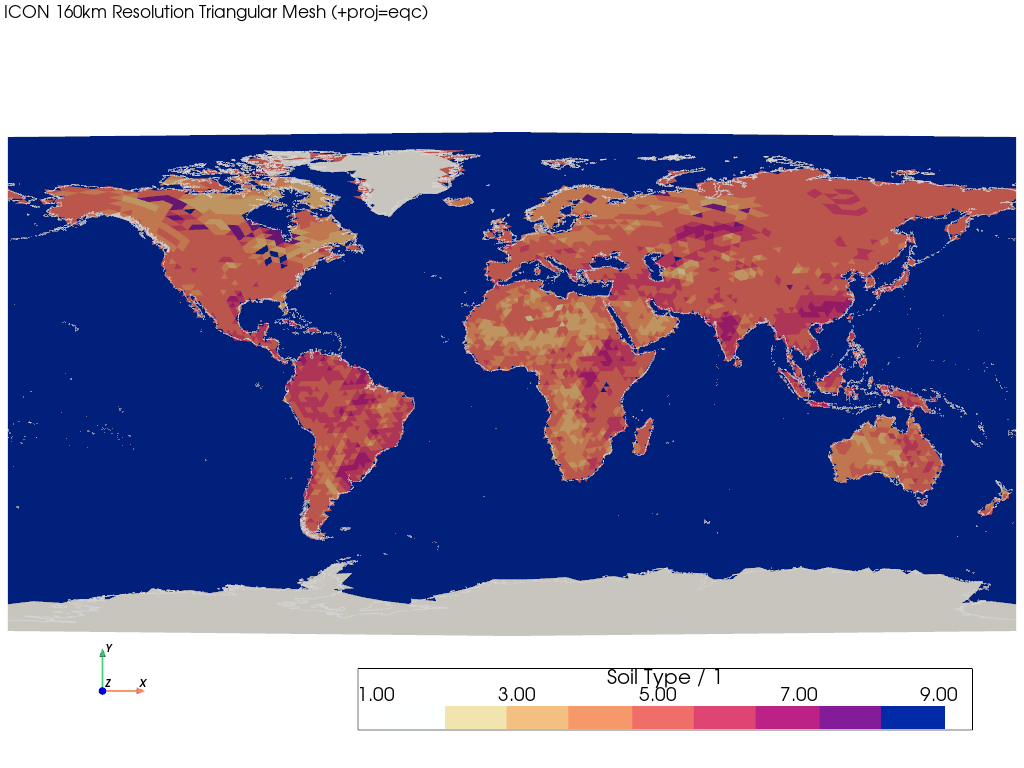
This example demonstrates how to render a projected unstructured triangular mesh.
📋 まとめ#
Creates a mesh from 2D latitude and longitude unstructured cell bounds.
The resulting mesh contains triangular cells.
It uses Icosahedral Nonhydrostatic Weather and Climate Model (ICON) global 160km resolution soil type data, as developed by the Deutscher Wetterdienst (DWD) and the Max-Planck-Institut für Meteorologie (MPI-M). The data targets the mesh faces/cells.
Note that Natural Earth coastlines are also rendered, and the mesh is transformed to the Equidistant Cylindrical (Plate Carrée) conformal cylindrical projection.
from __future__ import annotations

import matplotlib as mpl

import geovista as gv
from geovista.pantry.data import icon_soil


def main() -> None:
    """Plot a projected ICON unstructured mesh.

    Notes
    -----
    .. versionadded:: 0.1.0

    """
    # Load the sample data.
    sample = icon_soil()

    # Create the mesh from the sample data.
    mesh = gv.Transform.from_unstructured(
        sample.lons,
        sample.lats,
        data=sample.data,
        name=f"{sample.name} / {sample.units}",
    )

    # Plot the unstructured mesh.
    crs = "+proj=eqc"
    p = gv.GeoPlotter(crs=crs)
    cmap = mpl.colormaps.get_cmap("cet_CET_L17").resampled(lutsize=9)
    p.add_mesh(mesh, cmap=cmap)
    p.add_coastlines()
    p.add_text(
        f"ICON 160km Resolution Triangular Mesh ({crs})",
        position="upper_left",
        font_size=10,
    )

    # Define a specific camera position.
    p.view_xy()
    p.camera.zoom(1.5)

    p.add_axes()
    p.show()


if __name__ == "__main__":
    main()